

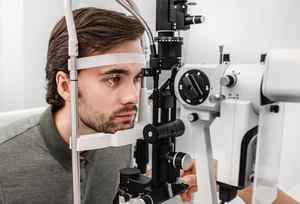
A wide range of eye-related problems do not cause noticeable symptoms at first. In order to give yourself the best chance of having such issues caught before they can lead to vision loss, it’s recommended that you undergo at least one comprehensive eye exam every year. Below is a brief overview of what you can normally expect during this appointment, including some of the tests that your optometrist might perform.
A Review of Your Health History
Your optometrist needs a full picture of the overall state of your health so that they can accurately assess your risk of developing certain vision problems. As such, your exam may include a brief look at your health history. Be sure to mention any medications you are currently taking as well as any health conditions that you’ve experienced in the past.
Visual Acuity Test
If you’ve visited an optometrist before, you probably remember having to read letters on a chart from a distance. This is the visual acuity test, which evaluates how clear or sharp your vision is in each eye. The results of this test are expressed in fraction form, with the first number referring to distance and the second number being the smallest size you could successfully read. So if your result was 20/30, you need to be within 20 feet to read a letter that someone with 20/20 vision could read from 30 feet away.
Refraction Test
Anyone who requires corrective lenses must undergo a refraction test. This is done to determine the correct lens power for your glasses or contacts. The test involves placing lenses in front of your eyes with a special instrument known as a phoropter. Your optometrist will switch between the lenses and ask you which ones give you the clearest view of the chart. The results of the refraction test are vital for making an accurate lens prescription.
Pupillary Response Test
Your optometrist needs to check how well your pupils are functioning. To do so, they will perform a pupillary response test, which involves briefly exposing each eye to a bright light. The reaction of the pupils can potentially be used to diagnose certain issues with the optic nerve or the brain.
Ocular Motility Test
For an ocular motility test, your optometrist will have you follow an object with your eyes while they move it around. This gives them a chance to make sure that your eyes are moving and coordinating properly. Thanks to this test, it’s possible to identify warning signs of weak eye muscles.
Bear in mind that your comprehensive eye exam may involve other tests in addition to the ones listed above. Each of these tests plays a crucial role in identifying potential vision issues so that they can be addressed as promptly as possible.
About the Author
Dr. Jordana Chettiparampil is a therapeutic optometrist in Richmond who enjoys having the opportunity to improve the overall well-being of her patients. She is a graduate of the University of Houston College of Optometry, and she currently holds membership with the American Optometric Association as well as other organizations. She is proud to offer comprehensive eye exams for adults and children alike. To schedule your next eye exam with Dr. Chettiparampil at Richmond Eye Experts, visit her website, use her online scheduling tool, or call (832) 685-2020.